UFOs Don't Matter on Election Day

By Douglas Dean Johnson
@ddeanjohnson on X and Bluesky
This article was originally published on October 27, 2026, at 11:45 AM EDT. Any substantive additions, revisions or corrections made after the initial publication will be recorded in a chronological log found at the end of the article. If you are not currently receiving new articles by email, visit the website and click on one of the "subscribe" buttons. There is no charge, and I will not put your email address on any other list. My Gmail address is my full name– first.middle.last– with periods between the names.
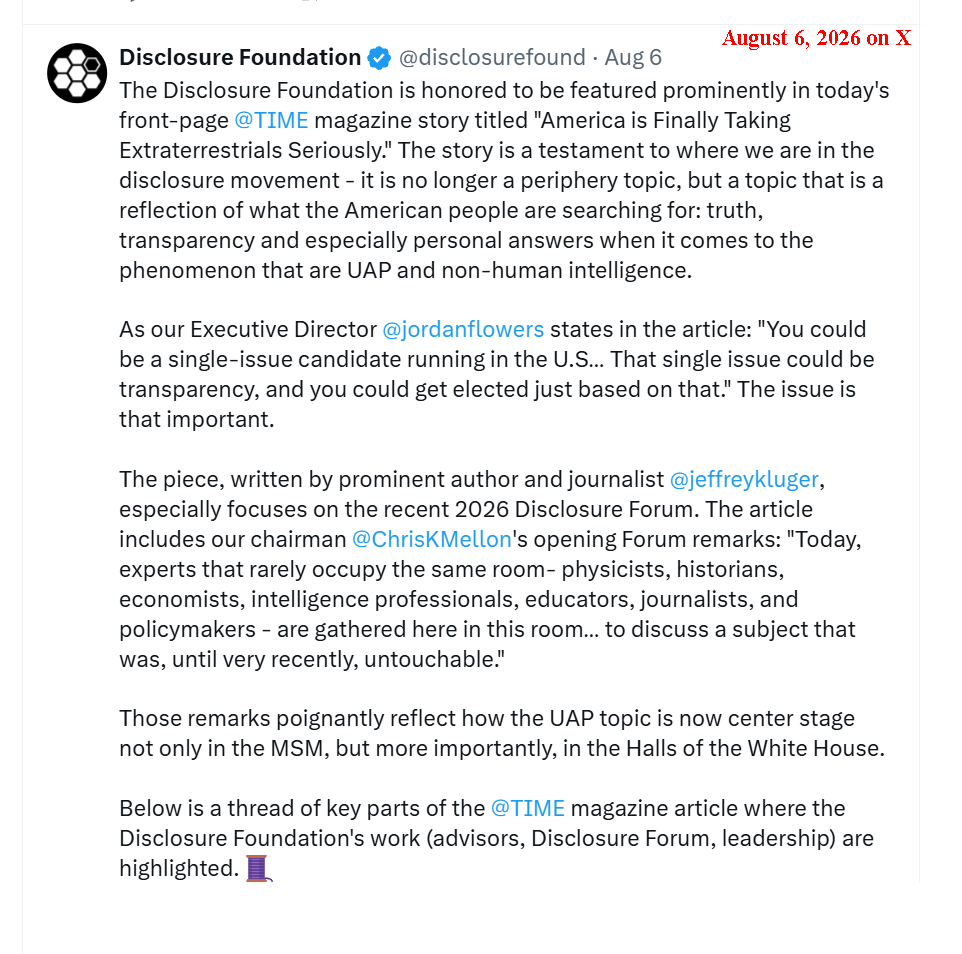
"You could be a single-issue candidate running in the U.S. ... That single issue could be transparency, and you could get elected just based on that." – Disclosure Foundation Executive Director Jordan Flowers (the identical quote appeared on August 6, 2026 in TIME magazine online and in a Disclosure Foundation X post later that day, both in the context of interpreting a Foundation-sponsored public opinion poll on "Public Sentiment on UAP Transparency")
“For members of Congress who are part of the UAP caucus and working on UAP legislation, we will closely monitor their primary and general election races. ... Currently, lawmakers face no political repercussions for opposing UAP-related measures, and this is precisely what we need to change moving forward. In addition to supporting lawmakers who are serious about the issue, we must also make our voices heard to those who oppose the legislation." – Yuan Fung, executive director of the UAP Disclosure Fund, in Liberation Times, June 9, 2024
"Regardless of party, I will mobilize and rally American voters. They will demand an honest, open, and transparent government. Together, we will win the disclosure of our government’s UAP secrets, and we will do so the easy way, or we’ll do it the hard way.” – Danny Sheehan, founder of the New Paradigm Institute, December 4, 2023
"Certainly there's political objectives. The midterms are coming up, and certainly these kind of [UAP] disclosures would help the MAGA movement and the Republican Party." – Former intelligence officer David Grusch, interview with Chris Farrell, May 5, 2026
"I've taken a risk. My campaign manager hates that I'm investigating this topic. It doesn't do me any good to climb any kind of ladder politically." – Rep. Eric Burlison (R-MO), The Dr. Phil Podcast, October 15, 2026

Controversial claims about UFOs and purported alien visitation are frequently encountered these days on social media; in podcasts, interview shows, and movies; and on the New York Times bestseller list. For some who have long followed these topics closely, it may seem like the topic has finally become a mainstream preoccupation.
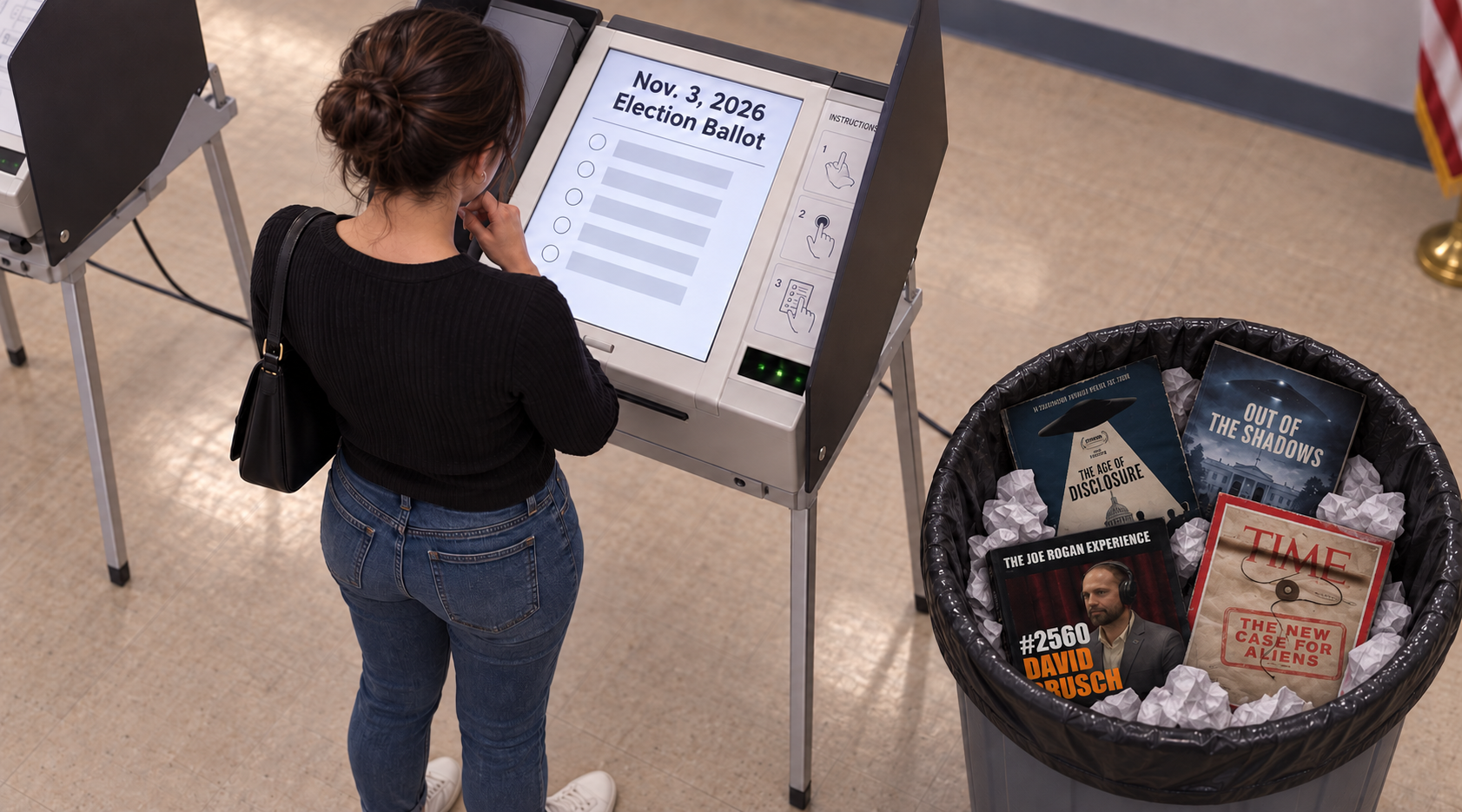
Whatever the actual level of general public interest in the topic, however, one thing is clear enough: UFOs and aliens just don't matter on Election Day. As far as electing federal officeholders goes, the entire UAP debate has hardly yet risen to the level of background noise.
Available evidence suggests that the position of a candidate on UAP, whether as an advocate of ‘disclosure’ or as a critic of UAP claims, does not drive any appreciable number of votes. Maintaining a high profile on the topic has not been shown to allow a candidate to tap into any significant reservoir of political assets, such as volunteer turnout, substantial campaign contributions, or backing from groups that have the capacity to reach and motivate like-minded voters. Nor has attacking an opponent for fooling around with UFOs emerged as a viable tactic (although one competitive congressional candidate is currently giving it just a bit of a try, as discussed below).
There is no record of a candidate's position on anything related to UFOs ever playing a significant role in the actual outcome of any congressional primary or general election in the United States. I am not saying that the subject has never come up, but rather that it has never played any demonstrable role in determining an election outcome--or even mattered much.
This election cycle, it appears that UFOs will once again have no discernible impact on the results in any election for a seat in the U.S. Senate or the U.S. House of Representatives. The November 3, 2026 general election will determine which party controls the U.S. House of Representatives and U.S. Senate for the last two years of the second Trump Administration, beginning on January 3, 2027, the day the election winners will be sworn in.
Which party controls Congress, or whether control is split, in turn will determine what Congress spends its time on during 2027-2028, and to a considerable degree affect the pursuit of the policy goals of the Trump Administration, including UAP "transparency." [1]
In June 2026, the Disclosure Foundation released a F'inn poll of 303 U.S. adults that found 84% of respondents want more information from the government on UAPs, 69% believe UAPs are real, 59% support hearings and transparency laws, and only 21% count the federal government among the most-trusted sources of information regarding UAP. [2]
Commenting on the poll, Disclosure Foundation Executive Director Jordan Flowers said, "You could be a single-issue candidate running in the U.S. That single issue could be transparency, and you could get elected just based on that.” This quote appeared on the TIME website on August 6, 2026, in the article that was featured on the cover of the August 17 paper edition as "The New Case for Aliens." We can be sure it was not a misquote, or taken out of context, because the exact same Flowers statement appeared verbatim later on August 6, and in the same context (i.e., referring exclusively to UAP disclosure), in a Disclosure Foundation post on X.
In my view, Flowers' statement was entirely detached from political reality. The F'inn poll results provide no support for the proposition that one could run a successful congressional campaign on the theme of UAP transparency--or even that any UAP-related issue has any significant vote-driving capacity under current circumstances.
A far more realistic assessment was well expressed by longtime UFO researcher/author John B. Alexander in an exchange with podcaster Jimmy Church: "You get to the voting issue. What are the issues that people vote on? And UFOs is not one of them, except for a very tiny subset." (Fade to Black, August 25, 2025)
To test my own assessment of Flowers' statement, I submitted it and its context to a number of well-established political pollsters and consultants.
Zac McCrary, a Democratic pollster and political strategist with Impact Research, said, "I'd tell such a candidate that this is not an issue of day-to-day concern of voters and a candidate making it an important part of his or her campaign would be viewed as out-of-touch with the pocketbook concerns that dominate most voters' outlooks." (August 17, 2026)
Neil Newhouse, a leading Republican pollster/strategist with Public Opinion Strategies, commented (August 14, 2026):
While public opinion data may back up assertions that Americans are taking the issue of UAP transparency more seriously, that is a far cry from that issue being a vote determinant in the upcoming election. Considering the fact that the country is embroiled in a longer than expected war in the Middle East, is facing an affordability crisis here at home, with housing, energy and grocery prices on the rise, the idea that a single issue candidate focused on UAP transparency could be successful is extremely unlikely. (And, this comes from a person who just watched 'Full Disclosure' last night!)
Kyle Kondik, managing editor of Sabato's Crystal Ball, a nonpartisan election forecasting and analysis newsletter published by the University of Virginia Center for Politics, said, "I really doubt this is the case because while the public may broadly support transparency on UAPs, it very likely is not a top issue for many voters." (August 14, 2026)
Among the political consultants whom I asked, the least negative reaction to the Flowers quote came from Celinda Lake, a veteran Democratic pollster who has done work for many liberal candidates and activist groups. She responded, "I think UAP transparency can be part of a general populist accountability agenda. To be a campaign message it would need to be coupled with other agenda items." (August 14, 2026) However, Lake did not respond to this follow-up question: "Do you know of any specific congressional race so far in which UFOs/UAP policy has successfully been employed as a substantial vote-mover?" [3]
WATCH WHAT THEY DO
The current electoral irrelevance of UAP/UFO/aliens is best demonstrated not by the words but by the near-universal behavior of political professionals nationwide--by which I mean, political consultants, pollsters, and campaign managers; people who run well-resourced issue-oriented groups and party committees; and the congressional candidates themselves.
Figures published by AdImpact suggest that roughly $5.4 billion ($5,400,000,000) will be spent just on advertising in 2026 cycle congressional races, by candidates, party committees and independent organizations. This would be the largest amount ever spent in a congressional election cycle. But in the months and weeks leading up to election day on November 3, nowhere in the United States has any campaign or group spent meaningful funds either to tout or to criticize UAP-related government activity– not even in targeted social-media ads or targeted mailings, insofar as this can be determined. If this is happening at all, it is on such a small scale that it is insignificant.
In only one congressional race, Florida's 13th congressional seat, currently held by Rep. Anna Paulina Luna (R), have I seen a competitive congressional candidate (Democrat Leela Gray) engage in even very limited rhetorical forays on a UAP theme (but no paid advertising), as discussed in detail below. In two other instances, incumbent House members highlighted their UAP interests in emailed solicitations to supporters, but long before election day. [4]
The dearth of any voter-facing, resource-consuming outreach efforts regarding UAP tells you that political professionals across the spectrum do not see UAP as a vote-driving issue– in either direction– not for any subset of the electorate that is big enough to matter.
WHAT PEOPLE TELL POLLSTERS THEY CARE ABOUT
My thesis is further supported by the results of recent national polls that asked people what issues are most important to them as the election approached. There have been multiple national polls that allowed respondents to answer freely (rather than choosing from a pollster-dictated menu), and that reported topics mentioned by as few as 1% of respondents. None of them registered UAP in any guise.
For example, a Washington Post/Ipsos poll conducted in July 2026 allowed respondents to name "the most important factors in your vote for Congress this year ... up to three," and published a list of all the issues named by as little as 3% of respondents. No UAP/UFOs or aliens.
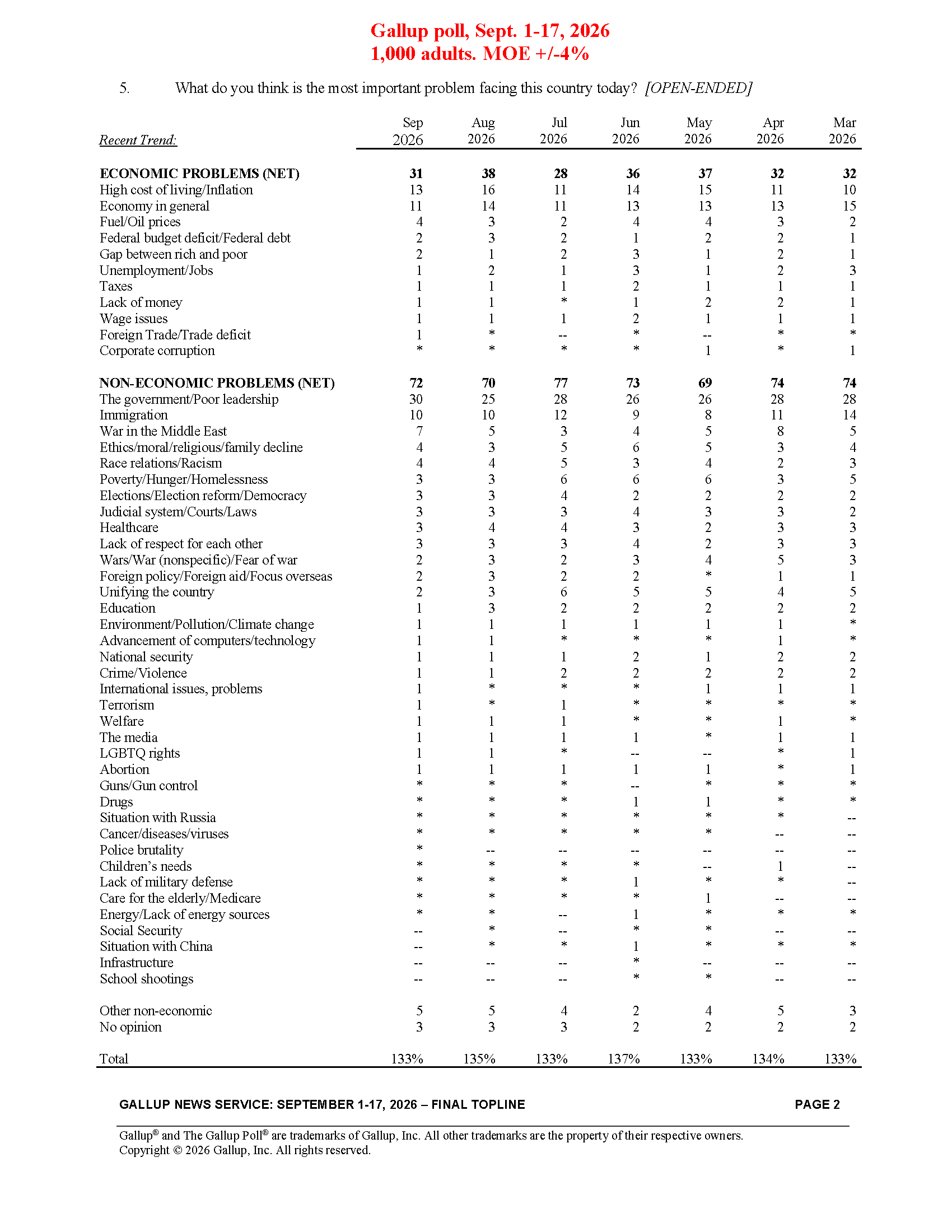
The Gallup Poll conducted September 1-17, 2026, asked 1000 adults, "What do you think is the most important problem facing this country today?" Responses were separated into "Economic Problems" (31%) and "Non-Economic Problems" (72%). Under the latter, 24 issues were named by at least 1%, and another 13 by enough respondents to be given a topical line– but nothing about UAP in that list of 37 topics. If anybody mentioned UAP disclosure or alien visitation, it must have been in the five percent lumped under "other non-economic."
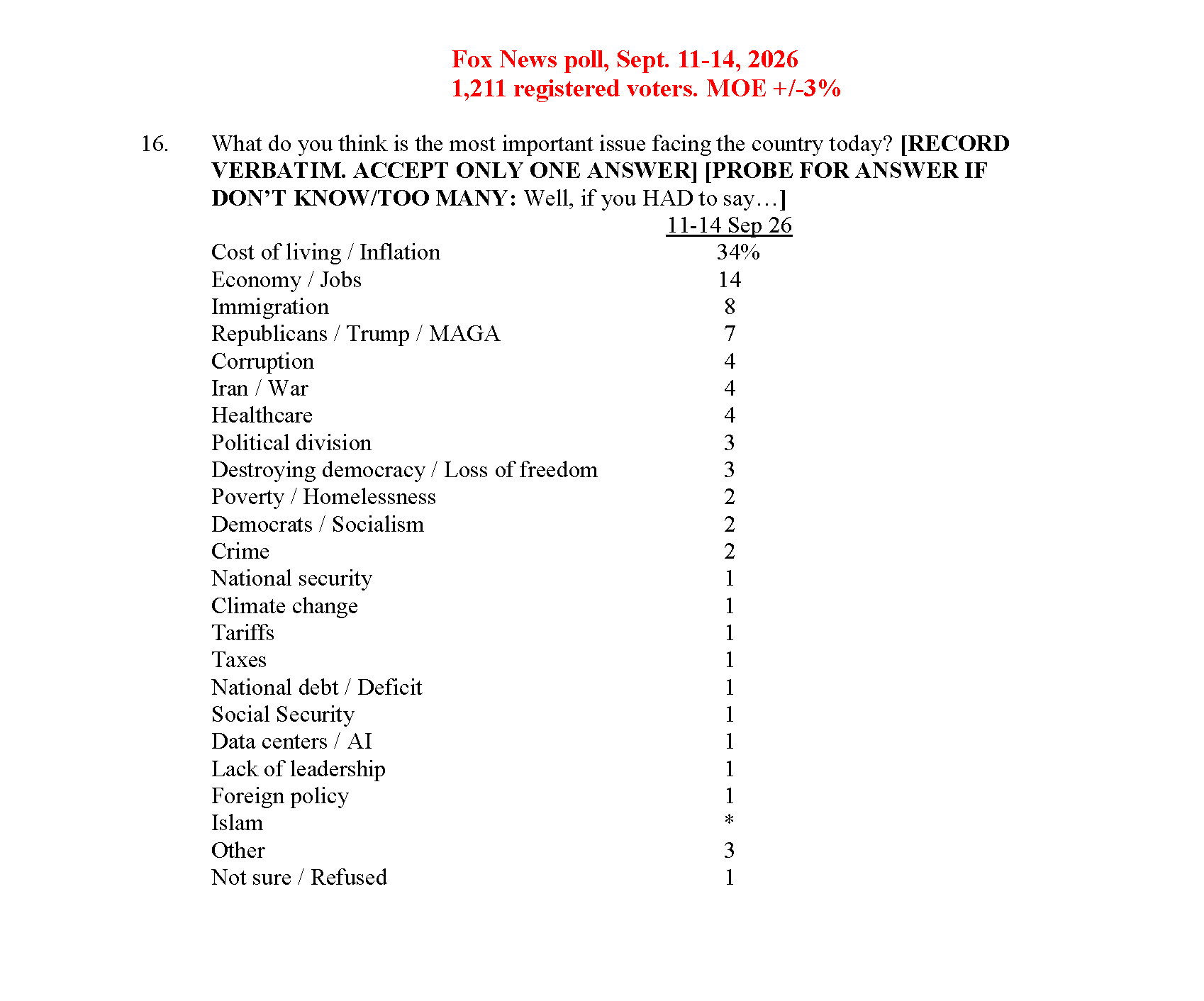
A Fox News poll conducted September 11-14, 2026, asked 1211 registered voters a very similar question and garnered a list of 21 issues that were named by at least 1%. If anybody responded with UFOs or aliens, it likely went into the 3% "other."
Hypothetically, of course, a voter might regard some other issue as "most important," yet still place substantial vote-determining weight on whether a candidate's view on UAP is in alignment with the voter's view. But there is little reason to believe that UAP is even a second- or third-tier vote-driver for any appreciable bloc of voters.
THE HISTORICAL RECORD
It appears that there has never been a primary or general election for any seat in the U.S. House of Representatives or U.S. Senate in which exit polls or any other credible data demonstrated that a candidate's statements or actions regarding UFOs/UAP had a discernible effect on voter choice or the election outcome. So far, it appears unlikely that this year will be the first to provide any contrary example.
[Over the decades a very small number of members of Congress have become involved in short-lived UFO-related controversies, including Rep. Dennis Kucinich (D-OH) in 2007-2008 and Rep. Gerald Ford (R-MI) in 1966, but evidence is lacking that any of those politicians were either substantially harmed or helped by their identification with the subject.]
I asked Kyle Kondik of Sabato's Crystal Ball, "Are you personally aware of any House or Senate primary or general election in which a candidate's statements on policies related to UFOs/UAP have ever appeared to move substantial numbers of votes, or materially affected which candidate won?" He replied, "I am not aware of any. I could be wrong but nothing comes to mind." (August 17, 2026)
RACES IN WHICH UAP ISSUES HAVE AT LEAST BEEN RAISED
Although those who spend perhaps too much time on "UFO X" might be surprised to hear it, during 2025-2026 there has been very little formal UAP-related legislative or investigative activity in either chamber of Congress. Moreover, the number of lawmakers visibly and actively engaged in UAP matters has dropped off since a peak in 2023. [5] [6]
Nevertheless, a small group of House members have remained visibly active throughout the 2025-2026 Congress, especially Reps. Anna Paulina Luna (R-FL), Eric Burlison (R-MO), Tim Burchett (R-TN), Jared Moskowitz (D-FL), and André Carson (D-IN). Two of these, Luna and Moskowitz, currently face competitive races for re-election.
Luna has enjoyed special prominence since House Oversight Committee Chairman James Comer (R-KY) created the Task Force on the Declassification of Federal Secrets (in effect, a temporary special-purpose subcommittee) in February 2025, naming Luna to chair it. The press release announcing creation of the task force mentioned seven topics that it would investigate, including "UAPs/USOs [unidentified submerged objects]".
In a Wall Street Journal profile published on June 14, 2026, headlined "The Congresswoman Who Knows Exactly How to Go Viral," the paper observed, "Key to Luna’s social media prowess is her ability to identify politically explosive issues that interest the GOP base. ... in her role as chair of the House Oversight Task Force on the Declassification of Federal Secrets, she often wades into popular conspiracy theories."
Both Luna and Moskowitz have continued to participate in D.C. based UAP-related events. For example, both appeared at a Capitol Hill press conference with David Grusch on June 9, and Luna spoke at a June 25 forum sponsored by the Disclosure Foundation. But as far as I can tell, neither campaign has included UAP-related material in its voter-facing campaign communications, such as TV and social-media advertising, press releases, or campaign websites.
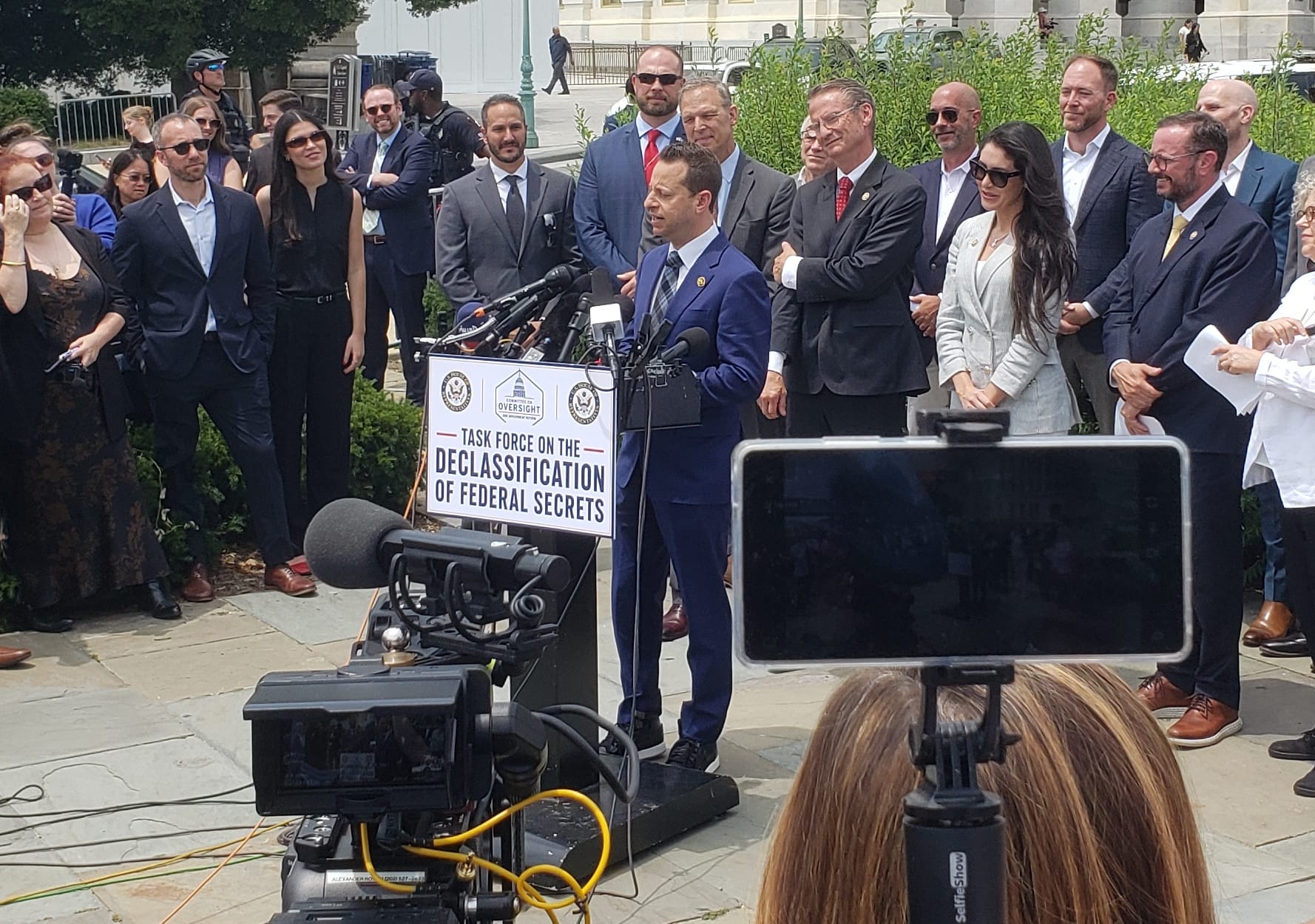
For example, on a Luna website page headed "Working for You," listing accomplishments, Luna mentions neither UAP investigations nor her role as chair of the Task Force on the Declassification of Federal Secrets.
Likewise, I found no mention of UAP on Moskowitz's campaign website, either in a section headed "Priorities" (listing 10 issues) or elsewhere.
This does not mean that Luna or Moskowitz are embarrassed or bashful about their UAP activism– there is nothing to suggest that– but it does indicate that they do not see it as an issue that will drive any significant number of uncommitted voters, or attract appreciable political resources (volunteers, donations, etc.) to their campaigns.
The Luna-Gray race is apparently unique in one respect: Luna's Democratic opponent, Leela Gray, a retired Army brigadier general, has on at least four occasions attacked Luna's UAP activism. After an initial swipe in an October 1 email, in an October 9 appearance on Morning Joe on MS NOW, Gray said Luna was "too busy chasing headlines, too busy worrying about space aliens, to show up actually for her constituents, and even hold a town hall, much less debate me."
Leela Gray, Democratic challenger to Rep. Anna Paulina Luna (R-FL), on Morning Joe on MS NOW, October 9, 2026.
Since then, Gray has followed up with two additional emails. The most recent, on October 17, featured a graphic of Luna next to an alien, accompanied by the charge that Luna "is focusing on UFOs and aliens instead of working to lower costs or protect affordable healthcare."
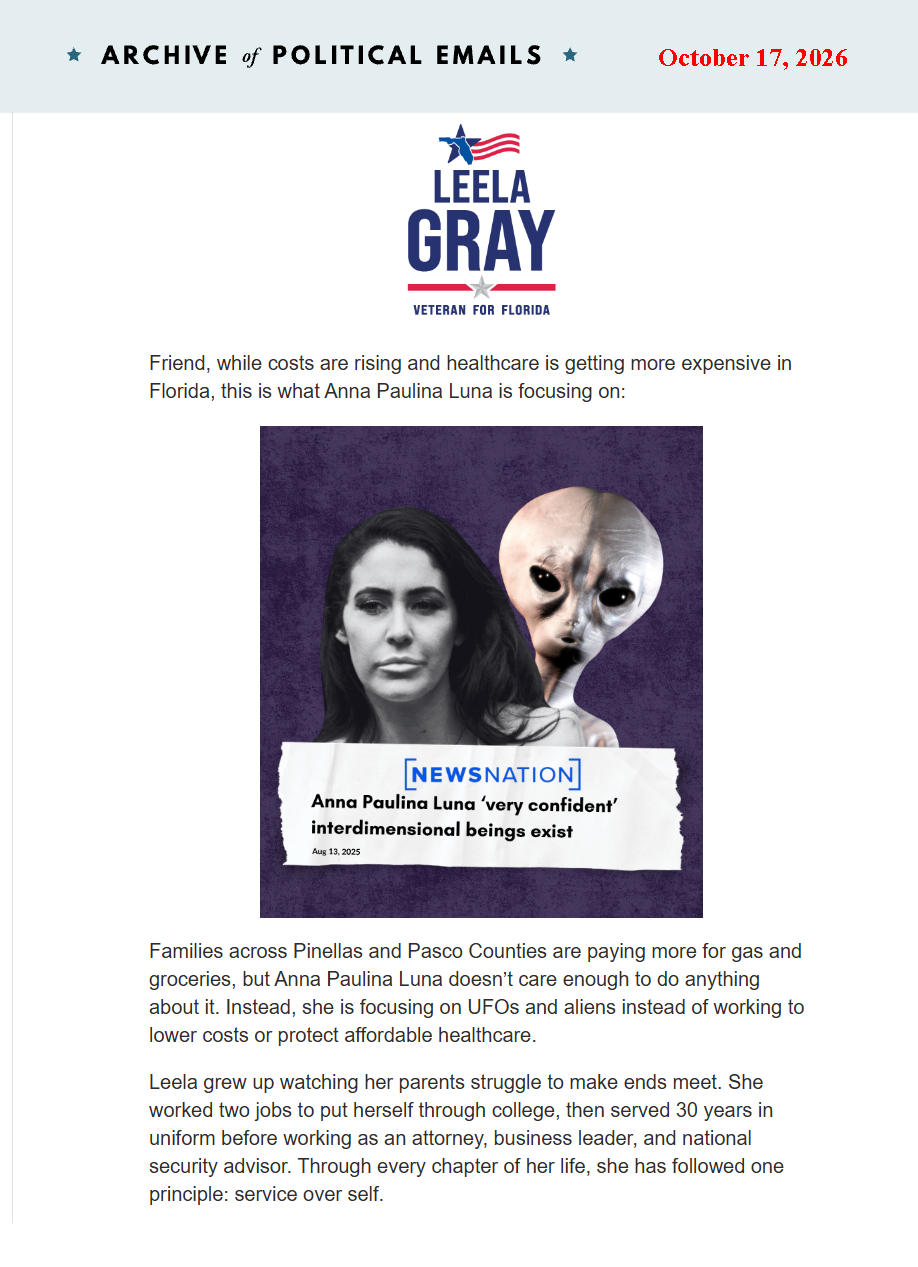
However, I have not seen any evidence that Gray has elevated this attack theme to the level of a TV ad or other paid advertising. Other than a release highlighting the October 9 Morning Joe appearance, I found nothing about the issue on Gray's campaign website. Nor, it seems, has the Luna campaign felt it necessary to respond to Gray's swipes on UAP. It should be noted that Luna did not accept Gray's challenges to a formal general public debate.
To keep Gray's verbal swipes in perspective, in this district alone (Florida's 13th congressional district), at least $14 million will have been spent by election day by the campaigns or by outside groups supporting or opposing either candidate, yet it appears that no identifiable sliver of that money will have gone towards any UAP-themed advertising or voter-mobilization efforts by either camp.
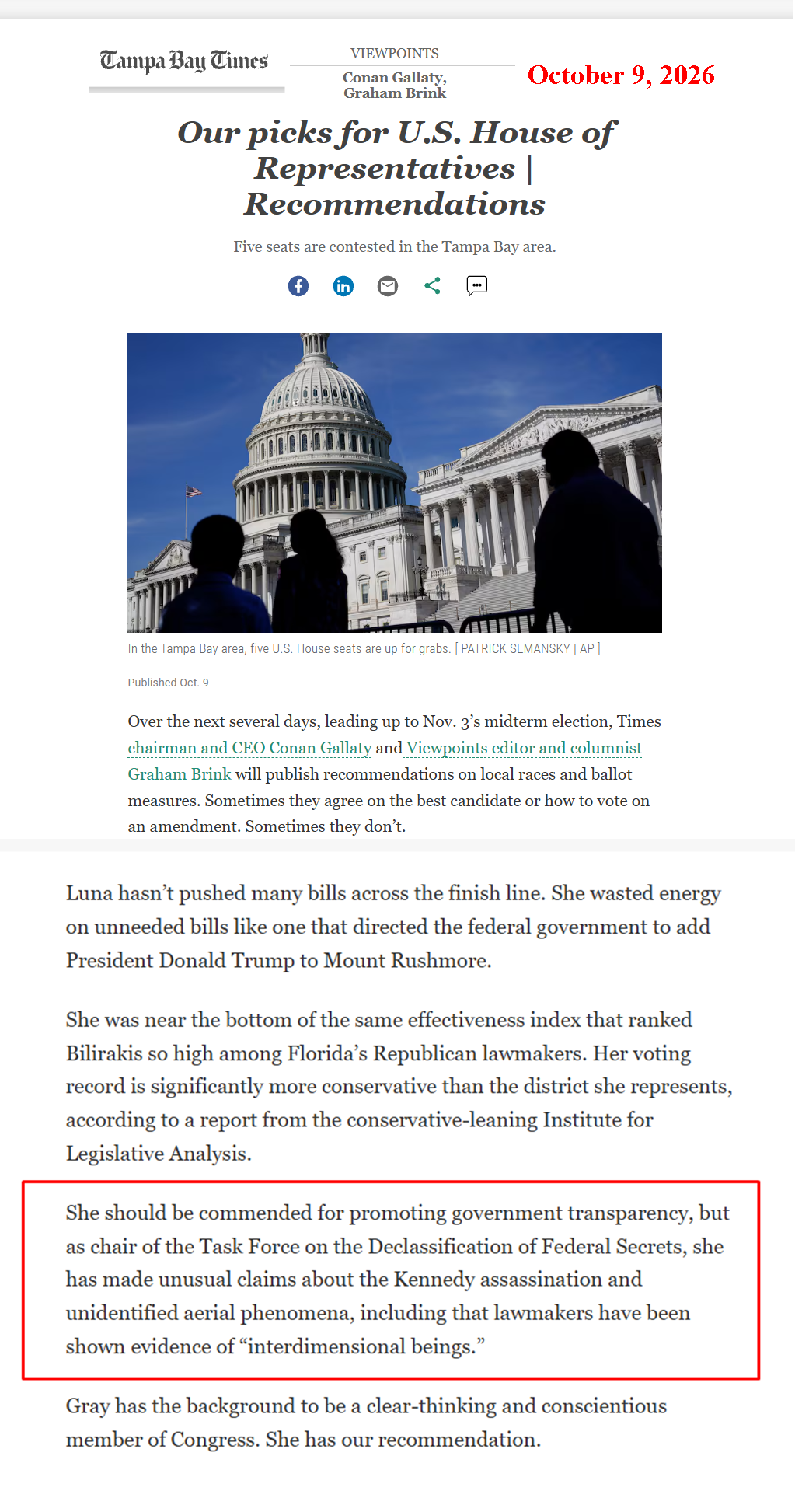
The largest-circulation newspaper in the district, the Tampa Bay Times, in an October 9 editorial endorsing Gray, mentioned that Luna "has made unusual claims about the Kennedy assassination and unidentified aerial phenomena, including that lawmakers have been shown evidence of 'interdimensional beings.'" But this paper also did not endorse Luna in her previous general election races.
Whichever way the Luna-Gray race comes out, hopefully someone will have conducted a competent exit poll. If there is a discernible segment of the electorate that regards congressional activity on UAP/UFOs/aliens as a vote-driving issue, then this appears to be the only race this year where such an effect conceivably might be detected. But I doubt that the issue will move any needle even here.
On the Senate side, Senator Mike Rounds (R-SD) is heavily favored for re-election. Rounds, a member of both the Armed Services Committee and the Senate Select Committee on Intelligence, is also the lead co-sponsor of the UAP Disclosure Act. He has given many interviews on UAP topics, some extended. He spoke at the June 25, 2026 Capitol Hill forum sponsored by the Disclosure Foundation. Among currently serving U.S. senators, Rounds certainly has the highest profile on UAP. Yet I found nothing to suggest that he, his opponent, the press, or any group has raised the issue in the campaign context in any visible manner. There is nothing about UAP on Rounds' campaign website.
Again, this does not mean that Rounds is reluctant to discuss the subject– far from it. But it does suggest that he recognizes that few South Dakota voters are going to the polls with UAP on their minds.
LET'S TAKE A LOOK AT HOW ALL THE MEMBERS OF CONGRESS VOTED ON UAP MEASURES. OH, WAIT– THEY DIDN'T.
On any public policy issue that political professionals believe has the capacity to motivate significant numbers of voters, there will eventually be roll call votes that place House and Senate members on record on that issue.
It is true that party leaders often go to considerable lengths to procedurally block or delay roll call votes on matters perceived as politically sensitive, in order to "protect" some members of their caucuses, particularly those members approaching competitive re-election campaigns. (House members serve two-year terms, senators six-year terms.) But leaders' powers to deflect recorded votes are not unlimited. On any issue on which at least one side sees substantial political advantage in forcing lawmakers to choose sides, eventually there will be recorded votes. Often those roll calls occur on measures that certainly will not become law in the short term; the purpose is to nail each member to a position, and then use the votes in political ads, and in other ways to mobilize interest groups and voter blocs.
Consider, then, that since the beginning of the modern "flying-saucer" era in 1947, no bill or amendment explicitly and in substantial part dealing with UFOs (by any terminology) has ever been subjected to a stand-alone roll call vote on the floor of either the U.S. House of Representatives or the U.S. Senate.
Yes, during 2020-2023 Congress did enact significant UAP-related provisions, including creating AARO and empowering it to receive information at all levels of classification, tasking the National Archives and Records Administration to gather certain UAP-related records, among other provisions. But all of those provisions were packed into huge defense or intelligence policy legislation (authorization bills), or funding bills, without a roll call vote on any UAP-specific amendment or bill ever occurring on the floor of the House or Senate.
As a long time close observer of congressional voting practices, I think that those lawmakers who have advanced UAP-related measures in Congress have recognized that forcing all members of either body to go on record via a roll call vote would likely backfire in a big way.
During 2026, Rep. Eric Burlison has energetically pursued approval of a version of the UAP Disclosure Act (UAPDA), a measure first proposed in 2023 by Senators Chuck Schumer (D-NY) and Rounds. The 62-page measure would create an "independent" temporary agency headed by a Senate-confirmed review board, empowered to search throughout the government, and elsewhere, for evidence of "nonhuman intelligence" and examples of "technologies of unknown origin," defined to include devices "incorporating science and technology that lacks prosaic attribution or known means of human manufacture." [7]
At a June 25, 2026 forum on Capitol Hill sponsored by Disclosure Foundation, Burlison said, "Right now we're trying to get that [UAPDA] made in order, so that when it comes to the floor, at least we get an opportunity to have a vote on the UAP Disclosure Act, and then you'll know who supports it and who doesn't."
Rep. Eric Burlison (R-MO) speaks about the UAP Disclosure Act to a forum sponsored by the Disclosure Foundation on Capitol Hill, June 25, 2026.
About a month later, with difficulty but perseverance, Burlison extracted permission from the House Rules Committee to offer the UAP measure on the House floor as an amendment to the FY 2027 National Defense Authorization Act (NDAA) (H.R. 8800). But when the moment came, Burlison did not force a roll call vote– instead, he agreed to allow his proposal to be wrapped into a 54-amendment package inserted into H.R. 8800 as a bloc on a voice vote, without debate and without a roll call (July 22, 2026). So much for learning "who supports it and who doesn't."
But this is not a criticism. If Burlison had insisted on a roll call, the likely result would have been defeat, perhaps by a substantial margin. The amendment very well might have been vocally opposed by one or more influential chairmen or ranking minority members. Even if that didn't occur, faced suddenly with an unexpected and little-known 62-page proposal dealing with "nonhuman intelligence" and "technologies of unknown origin," many lawmakers would vote no reflexively. [8]
Why? In part because there is a basic guideline for political self-preservation, said to have been impressed on newly sworn lawmakers by their elders for generations, which runs something like this: When you are forced to vote on any matter you know little about and that looks tricky, and there is no compelling political reason to go along with it (e.g., party leaders or allied interest groups insist), the safest vote is Nay. This is deemed the prudent course to prevent later being waylaid by attack ads based on a vote for something you didn't understand. A legislator can usually come up with some plausible reason for having initially voted Nay even if a proposal later proves popular, but he has voted Aye, he will have difficulty shaking off ownership if the topic proves toxic.
Senator Carl Hayden (D-AZ) expressed the principle succinctly on the Senate floor on July 12, 1951: "On advice of counsel I shall adopt the old maxim: when in doubt, vote no.” In 2001, Senator Joe Biden (D-DE) attributed similar counsel to Senator Russell Long (D-LA): "Around this place, when in doubt, vote no.”
If advocates of the UAPDA had forced roll calls on the measure in the House and/or the Senate, on any occasion from 2023 to today, and lost, it would have rendered non-viable any ambitious UAP-related legislation for the foreseeable future, and likely further dampened the already anemic investigatory exercises as well.
By avoiding a roll call vote in the House in July, Burlison kept his measure alive to be considered by the House-Senate negotiators who are now crafting a final FY 2027 NDAA behind closed doors. Although I think Burlison's proposal is unlikely to emerge from those negotiations (for reasons briefly addressed in End Note No. 9), that mode of failure will not have the same consequences as open rejection of a UAP measure by the full House. [9][10]
The constraints that I've discussed in this section are applicable generically, to nearly any legislative issue that does not have a well-organized, electorally consequential constituency. They exist over and above any arguments that might be mustered for or against the merits of the specific provisions of the UAP Disclosure Act, a discussion which falls outside of the scope of this article.
VOTER MOBILIZATION AND UAP-RELATED PUBLIC POLICY
Identifying significant numbers of like-minded voters on a single issue, reaching them with the right information at election time, and motivating them to base their votes solely or mostly on a specific public policy issue, requires suitably structured issue-oriented organizations with very substantial financial and human resources. It cannot be done solely or even mainly by candidates' campaigns or party committees.
No such organizations exist in any of the main UAP camps--those who believe that the government is concealing big UAP-alien secrets, those who don't believe that is the case but do believe that anomalous aerial phenomena exist, and those who believe it is all distracting and perhaps dangerous nonsense.
Again: No organizations currently have the capacity to reach and motivate substantial numbers of like-minded voters, at key times and places, in a way that will deliver votes to reward or punish candidates based on what they have done or failed to do, or what they say they will do, regarding any UAP-related public policy question.
Certainly, claims have been made. For example, in a June 9, 2024 article by Christopher Sharp, in an article headlined "New UFO Political Action Group to Support Pro-UAP Candidates in 2024 Elections," Yuan Fung, at that time the executive director of the UAP Disclosure Fund, said, “For members of Congress who are part of the UAP caucus and working on UAP legislation, we will closely monitor their primary and general election races.... Currently, lawmakers face no political repercussions for opposing UAP-related measures, and this is precisely what we need to change moving forward. In addition to supporting lawmakers who are serious about the issue, we must also make our voices heard to those who oppose the legislation." (Fung is currently listed as a founder and political strategist for the Disclosure Foundation, a 501(c)(3) educational-advocacy organization.)
In a similar spirit, on December 4, 2023, Danny Sheehan of the New Paradigm Institute said, "The UAPDA is must pass legislation. The public deserves the truth. ... I’m putting every Member of Congress, House and Senate, on notice. Pass the Schumer-Rounds amendment [UAP Disclosure Act]. Regardless of party, I will mobilize and rally American voters. They will demand an honest, open, and transparent government. Together, we will win the disclosure of our government’s UAP secrets, and we will do so the easy way, or we’ll do it the hard way.”
Nothing has happened in the real world since that corresponds in any measure to such bold pronouncements about "political repercussions" and "the hard way."
Even if one or more persons with vast financial resources popped up to support UAP-related election-directed activity, it is doubtful that money alone can move the issue into the realm of political relevance.
HYPOTHETICALLY, WHAT COULD CHANGE UAP's CURRENT POLITICAL NEAR-IRRELEVANCE?
Some current members of Congress have credulously embraced the guidance of hoaxers and manifestly subjective or deluded persons. Some of these lawmakers and their staff persons have accepted certain specific tales of "UFO crash recoveries" and captive alien tech that are mirages of purely human creation. At some point, some incumbent lawmaker is likely to encounter a challenger who figures out how to effectively weaponize the incumbent's close association with disreputable characters and related expenditures of time and resources chasing patently bogus claims.
I will not be at all surprised if the first congressional race in which a UAP issue really does substantially affect the outcome will involve an incumbent lawmaker who loses his seat in part because a challenger comes up with an ad that effectively ties the incumbent to one or more of the proliferating population of high-profile UFO-associated hoaxers, LARPers, and conspiracy-theory-susceptible sherpas.
On the other hand, one can conceive of hypothetical circumstances in which the political salience of UAP and aliens would ramp up rapidly, if the public were shown much better evidence in support of the proposition that some of the things seen in the sky are not of human origin.
Jennice Vilhauer, a clinical psychologist who is a member of the non-governmental UAP Science Advisory Council (UAPSAC) headed by Harvard Professor Avi Loeb, has written that at a meeting held on August 31, 2026, at the Office of the Director of National Intelligence (ODNI), the UAPSAC "was informed that the United States government has a preparedness plan in place should the existence of nonhuman intelligence (NHI) be confirmed. ... The existence of a preparedness plan does not mean that the government has confirmed the existence of NHI, believes confirmation is imminent, or is preparing to make any type of announcement. It does mean that the possibility of confirming NHI has been taken seriously enough to warrant advance planning."
In this day and age, "confirming NHI" would have to entail not just some form of official pronouncement that we have visitors–although that would surely get people's attention--but production of evidence that would withstand every manner of critical scrutiny.
Of course, if we indeed have visitors from otherwhere, they could change the political landscape enormously simply by making themselves generally known in unmistakable ways. At the Capitol Hill forum sponsored by the Disclosure Foundation on June 25, 2026, a member of the group's advisory board, former Senate Armed Services Committee professional staff member Kirk McConnell, said, "The NHI [non-human intelligence], whoever is coming here, gets a vote too, in how they behave and how they interact with us. And it seems like the pace of this is sort of picking up. So that can be a source of disclosure right there, what they decide to do."
Short of that, however, most likely the overwhelming bulk of the electorate will continue to pay the purported visitors no mind at all when they elect their political leaders.
END NOTES
[1] The thesis of this article is that the subjects of UAP/UFOs/aliens will have no discernible impact upon the 2026 congressional elections. But the overall election outcome will likely have substantial effects on UAP-related developments involving members of Congress, and indirectly affect ongoing activity within the Executive Branch as well.
For example, if the Democrats gain majority control of the House of Representatives, Rep. Robert Garcia (D-CA) would replace Rep. James Comer (R-KY) as chair of the House Committee on Oversight and Government Reform, which has been the venue for almost all of the formal UAP-related activity in the House during 2023-2026. Although Garcia showed active interest in exploring UAP matters before he became the ranking Democrat on the committee on June 24, 2025, his involvement has sharply diminished since then. I predict that if he becomes chairman, he will not extend the existence of the Task Force on the Declassification of Federal Secrets (of which he was originally the ranking minority member). Further, with somewhat less confidence, I think it likely that Garcia will regard further high-profile exploration of any UAP-related matters by any Oversight Committee components to be off-message for 2027-2028. (See also a short interview with Garcia conducted by journalist Matt Laslo on September 22, 2026.)
Among the other pertinent changes that a Democratic majority would bring: The chair of the House Permanent Select Committee on Intelligence (HPSCI) would pass to Rep. Jim Himes (D-CT), who has expressed strong disbelief in claims that the government has control of alien technology. "Any number of us have boiled the ocean for any evidence that we are hiding aliens or have spacecraft or whatever, and the answer is always, no, no, no, no, [from] all kinds of people," Himes told Matt Laslo on February 7, 2024.
On the other hand, a senior member of the HPSCI, Rep. André Carson (D-IN), has demonstrated a strong interest in UAP. As a subcommittee chairman in 2022, he convened the first congressional UAP-related hearing since the 1960s (May 17, 2022). He recently called for release of the long-withheld volume 2 of a historical review of government involvement in UAP matters, prepared by the All-Domain Anomaly Resolution Office (AARO).
[2] The F'inn survey was an online poll of only 303 U.S. adults, with a margin of error of approximately ±5.6 percent. The Disclosure Foundation's published report offered an interpretation that was much more modest than the August 6 Jordan Flowers statement: "Lawmakers have a public-permission base for sustained legislative action on UAP disclosure."
[3] I found a single congressional candidate whose campaign followed the Flowers model, up to a point. He is Lawrence Kellogg, a retired pilot who ran in the all-party ("jungle") primary for the 3rd Congressional District seat in Washington State. Kellogg made UAP transparency not his single issue, but no. 4 among "My Four Priorities" listed on his website, stating, "Your vote to send me to Congress is telling the government, in one more emphatic way, that you, too, want to know. The only boast I will make is that if you send me to Congress, I can get you disclosure--somehow." In the August 4, 2026 primary, Kellogg came in sixth, with 1.27% of the vote.
[4] In October 2025, Rep. Lauren Boebert (R), who represents a competitive district (Colorado's 4th congressional district), sent an email solicitation highlighting UAP disclosure to a conservative list. A would-be Democratic candidate, John Padora, sent out a critical email, stating, "While the government remains shut down and workers go without pay, Boebert is chasing UFO conspiracies instead of fighting to reopen the government and help Coloradans make ends meet. ... It’s completely out of touch. No one cares about space or aliens right now when we’re worried about our next paycheck, our rent, and putting food on the table!" However, Padora failed to qualify for the Democratic primary ballot. The local Fox affiliate did a report on the Boebert email, with a campaign source saying that the digital fundraising campaign was "performing extremely well," yet I found nothing to suggest that Boebert repeated the disclosure solicitation theme, or that she has employed any UAP themes in voter-facing communications during summer or fall of 2026. I also found no UAP-related utterance by Boebert's general-election Democratic challenger, Eileen Laubacher, a retired two-star admiral.
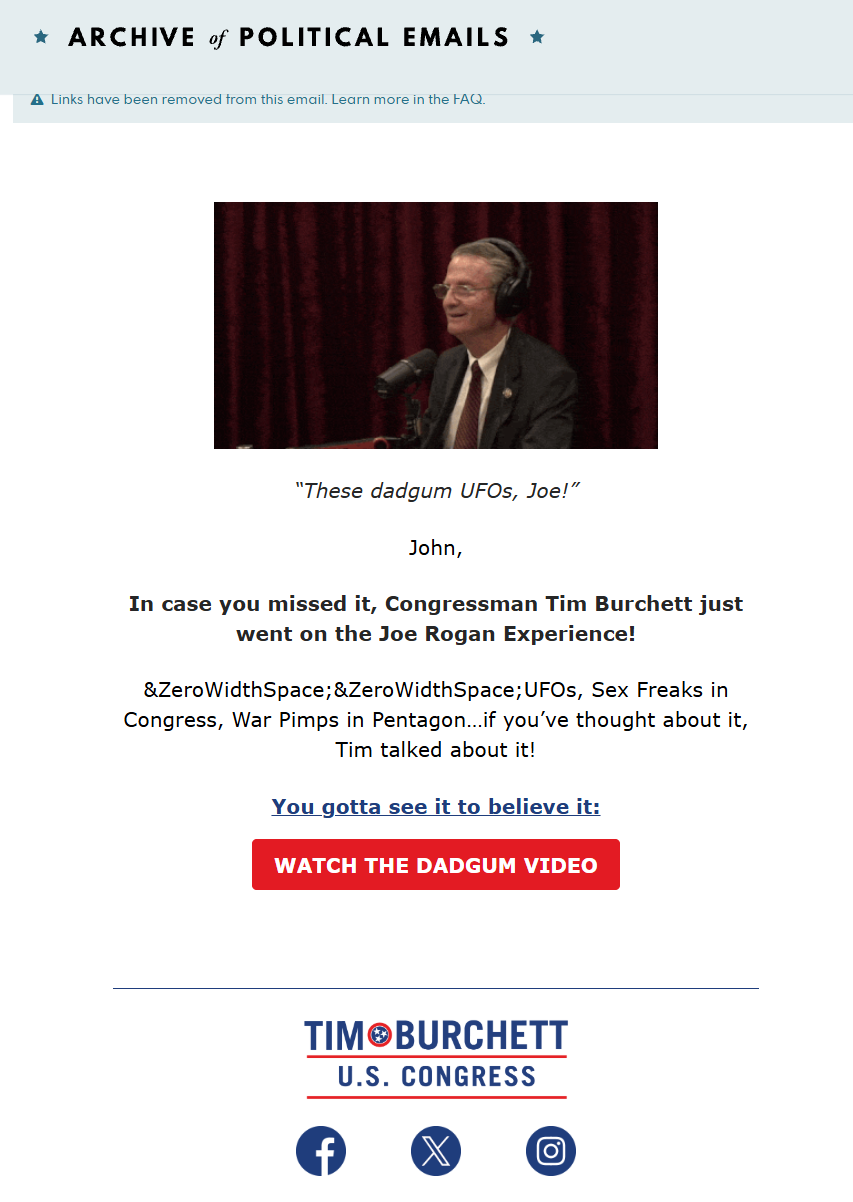
Rep. Tim Burchett (R-TN), who has a safe seat, sent out a couple of emails May 11-12, 2026, highlighting his appearance on the Joe Rogan Experience; these emails mentioned UFOs, but seemed intended mostly to tout Burchett's association with the popular podcaster. I found no UAP themes in Burchett's later campaign advertising.
[5] The only UAP-related hearing so far during the 2025-2026 Congress occurred on September 9, 2025, before the Task Force on the Declassification of Federal Secrets, a temporary panel created by House Oversight and Government Reform Committee Chairman James Comer (R-KY) and chaired by Rep. Anna Paulina Luna (R-FL). The topic of the hearing was "Restoring Public Trust Through UAP Transparency and Whistleblower Protection." The task force later published a transcript of the hearing, but it did not make witness biographies available as is usually the practice for hearings before standing subcommittees. Nor did the task force later publish any investigatory report relating to the hearing testimony or any other subject regarding UAP.
[6] On September 29, 2026, the House Oversight and Government Reform Committee issued a press release and 16-page booklet summarizing its accomplishments during the 2025-2026 Congress. Neither the press release nor the booklet contained any mention of UAP. The committee's Task Force on the Declassification of Federal Secrets was mentioned only in an non-topical count of hearings held by each of the full committee's subcommittees and task forces.
[7] The lead co-sponsor of the UAP Disclosure Act, Senator Mike Rounds (R-SD), who serves on both the Intelligence and Armed Services committees, has indicated on several occasions that he does not have personal knowledge of any captive alien technology. For example, during a June 30, 2025 interview with Ross Coulthart of NewsNation, when Coulthart posed "a hypothetical" on whether the public should be told if "the United States has recovered, incredibly, non-human technology, perhaps even craft and bodies biologics," Rounds said, "You do have a hypothetical. We're not aware of anything along that line that's ever been hidden from Congress directly, that we're aware of. ... The third alternative [for some UAP sightings, non-human technology], which I wouldn't be afraid of seeing someday, but we haven't seen that yet." [See video clip below.]
Senator Mike Rounds (R-SD) denies personal knowledge of government possession of any nonhuman craft or bodies, during interview with Ross Coulthart of NewsNation, June 30, 2025. Four-minute clip from 46-minute interview; Fair Use under 17 U.S. Code § 107 for noncommercial purposes of investigative journalism, scientific research and debate, education, commentary, and criticism.
[8] I say that the UAP Disclosure Act is "little known" because it is indeed little known, outside of the narrow segment of the population that avidly follows UFO-related news through specialized platforms. It has never received much coverage in the mainstream press, and on only a few isolated occasions since it was unveiled in July 2023 has its prime sponsor, Sen. Chuck Schumer (D-NY), made any special effort to draw attention to it.
Other than the rather small number of lawmakers who have had occasion to deal directly with the measure (such as senior NDAA negotiators), I think that few of the 535 voting members of Congress know anything about the UAPDA. Although the measure is 62 pages long and proposes to create a temporary new federal agency with expansive powers to delve into a very controversial area, the measure has never been the subject of a public hearing in either chamber, or a roll call vote in any committee of either chamber, much less a roll call in the full Senate or House of Representatives. In the Senate in July 2023 and in the House in July 2026, the UAPDA was inserted into massive National Defense Authorization bills as parts of very large block amendments, constructed through low-visibility negotiations, before being cleared by the respective chambers without debate and surely without awareness by most members of the respective chambers.
[9] House-Senate negotiators are already far along in crafting the contents of a final FY 2027 National Defense Authorization Act (NDAA), which will be presented to the House and Senate in unamendable form during the post-election lame-duck session in November-December 2026. I think that this negotiation process will not result in enactment of the review board with broad powers. I think it will likely again be dropped because (1) as the article you are reading argues, there is no politically significant movement demanding such legislation, and (2) there is no indication that anyone within the Trump Administration thinks Congress should create a new agency with a four-year plan, in order to uncover whatever UFO secrets the government may hold. The Trump Administration is well known for its expansive view of the scope of executive authority, not least in areas touching on national security. Indeed, there is no publicly visible indication that the Trump Administration has asked Congress to do anything at all regarding UAP, either with respect to legislation or investigations and oversight. (As the second year of the second Trump Administration draws to a close, with Republican control of both chambers of Congress, not a single UAP-related subpoena has been issued by any congressional committee.)
In a future article I might further explore the lack of Executive Branch support for the UAPDA, under both the Biden and Trump administrations.
[10] Neither in 2023 nor in subsequent years has there been evidence of any discernible lobbying against the UAP Disclosure Act by "defense contractors," mythology to the contrary notwithstanding. The decisive opposition has originated in the Executive Branch. On several occasions, Senator Mike Rounds (R-SD), the chief cosponsor of the UAPDA, has attributed its failure in part to concerns by some lawmakers about inadvertent disclosure of "our own capabilities," i.e., human-developed technological advances that need to remain classified. The clip embedded below is from a June 30, 2025 interview of Rounds by Ross Coulthart of NewsNation.
Senator Mike Rounds (R-SD) explains reasons he thinks some legislators have opposed his UAP Disclosure Act, during interview with Ross Coulthart of NewsNation, June 30, 2025. Two-minute clip from 46-minute interview; Fair Use under 17 U.S. Code § 107 for noncommercial purposes of investigative journalism, scientific research and debate, education, commentary, and criticism.